Automotive UX · Multisensory Interaction · Adaptive User Experience
Multisensory In-Vehicle Experiences for Driver Engagement
2023–2025 | Purdue University × Ford Motor Company
UX & Human Factors Researcher
Overview
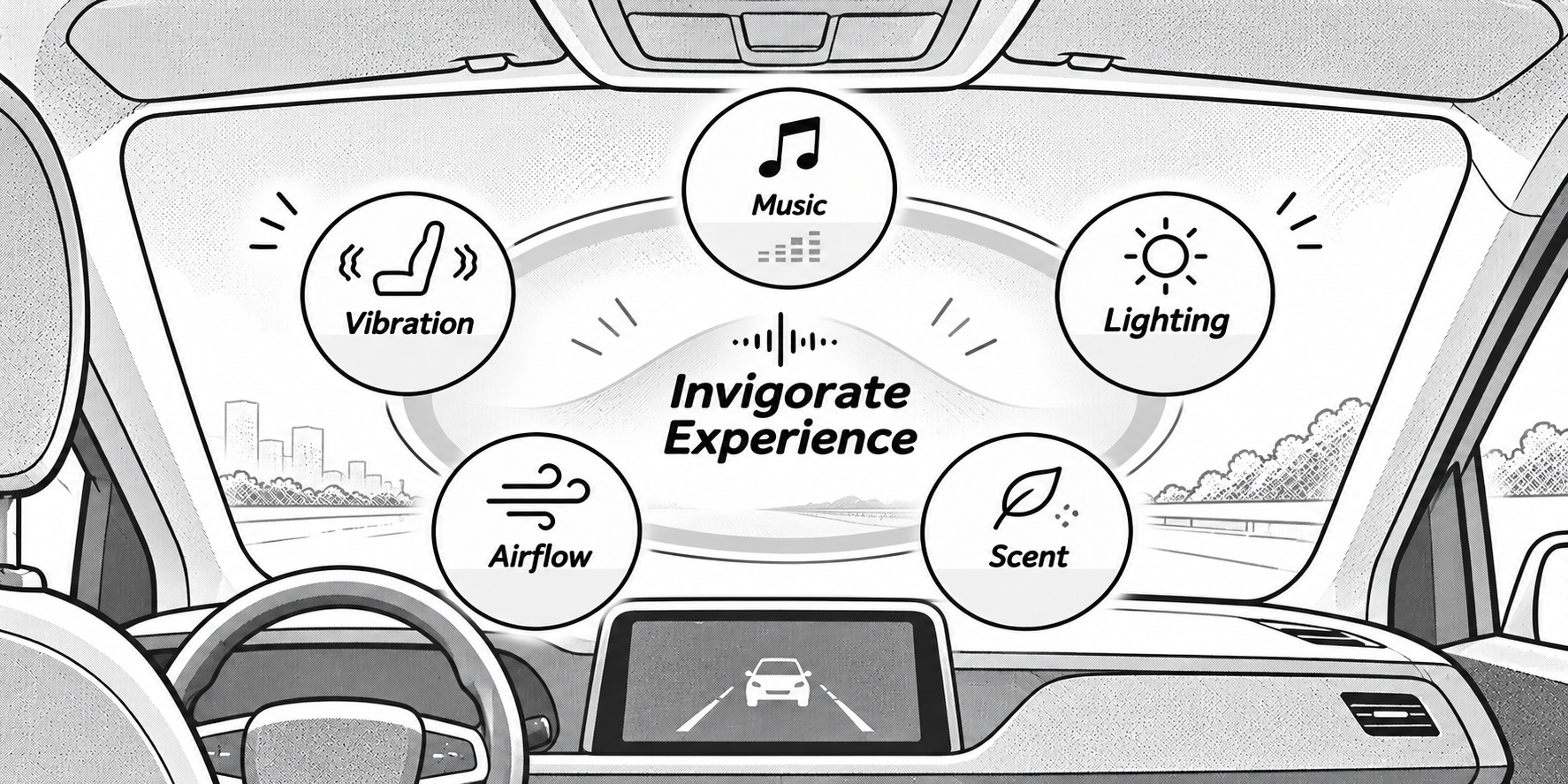
In collaboration with Ford Motor Company, we evaluated the Invigorate Experience, an in-vehicle system that synchronizes music, seat vibration, ambient lighting, airflow, and scent to support driver alertness and emotional well-being.
Background & Research Questions
Prolonged, monotonous driving can reduce alertness and engagement. Conventional driver alerts can interrupt the driving experience, and their effects on alertness may be short-lived.
We evaluated the Invigorate Experience in real-world driving to understand when and under what conditions it works best and inform the design of future in-vehicle multisensory experiences.
- Effectiveness. Can the Invigorate Experience improve driver alertness and emotional well-being?
- Context-Dependent Effectiveness. How do driving mode and stimulation duration, individually and in combination, influence drivers’ alertness and emotional responses over time?
Research Approach
To support the evaluation, we developed a GUI-based real-time vigilance detection prototype that monitors driver alertness and helps determine when to trigger the multisensory experience.
We conducted laboratory evaluations followed by an on-road study with 45 drivers to examine the system’s effects on driver alertness, emotional responses, and user acceptance.
We combined eye tracking, physiological sensing, driving behavior analysis, and subjective feedback to evaluate how drivers responded to and experienced the system.
Key Insights
- Drivers reported feeling more alert immediately after stimulation began. Objective measures related to vigilance also changed.
- Positive emotional responses and changes in alertness varied over time and across driving conditions.
- 87% of participants expressed interest in having the experience in their personal vehicles.
My Contributions
Lead Student Researcher | End-to-End UX & Human Factors Research
As the lead student researcher, I managed and contributed to the research process from study design through evaluation and stakeholder communication.
- Research Design: Designed experiments, research protocols, questionnaires, and user surveys to evaluate driver alertness, emotional responses, and user experience.
- Prototype & Pilot Testing: Developed and evaluated a GUI-based vigilance detection prototype to support real-time monitoring and intervention triggering; conducted pilot testing to refine the study procedures.
- User Study Execution: Planned, coordinated, and conducted laboratory evaluations and real-world on-road user studies.
- Quantitative & Qualitative Analysis: Analyzed multimodal behavioral, physiological, and survey data; synthesized qualitative user feedback using affinity diagramming to identify user needs, preferences, and experience-related insights.
- Research Synthesis & Stakeholder Communication: Translated research findings into actionable design recommendations, authored technical reports, and presented results to Ford stakeholders.
UX Design Implications
Coordinated multisensory cues offer another way to support drivers during monotonous driving. Future in-vehicle systems could adapt when and how long to deliver these cues based on driver state, user preferences, and the desired emotional experience.
Publications
Lab study
On-road study
- Turning Perceptions into Design Recommendations: Exploring the Implications of Multisensory Stimuli on Alertness and Mood in Manual and Partially Automated Vehicles (AutoUI, 2025)
- Temporal Dynamics of Ocular and Physiological Responses to Multisensory Stimulation Across Different Driving Modes and Stimulation Durations (HFES, 2026)